
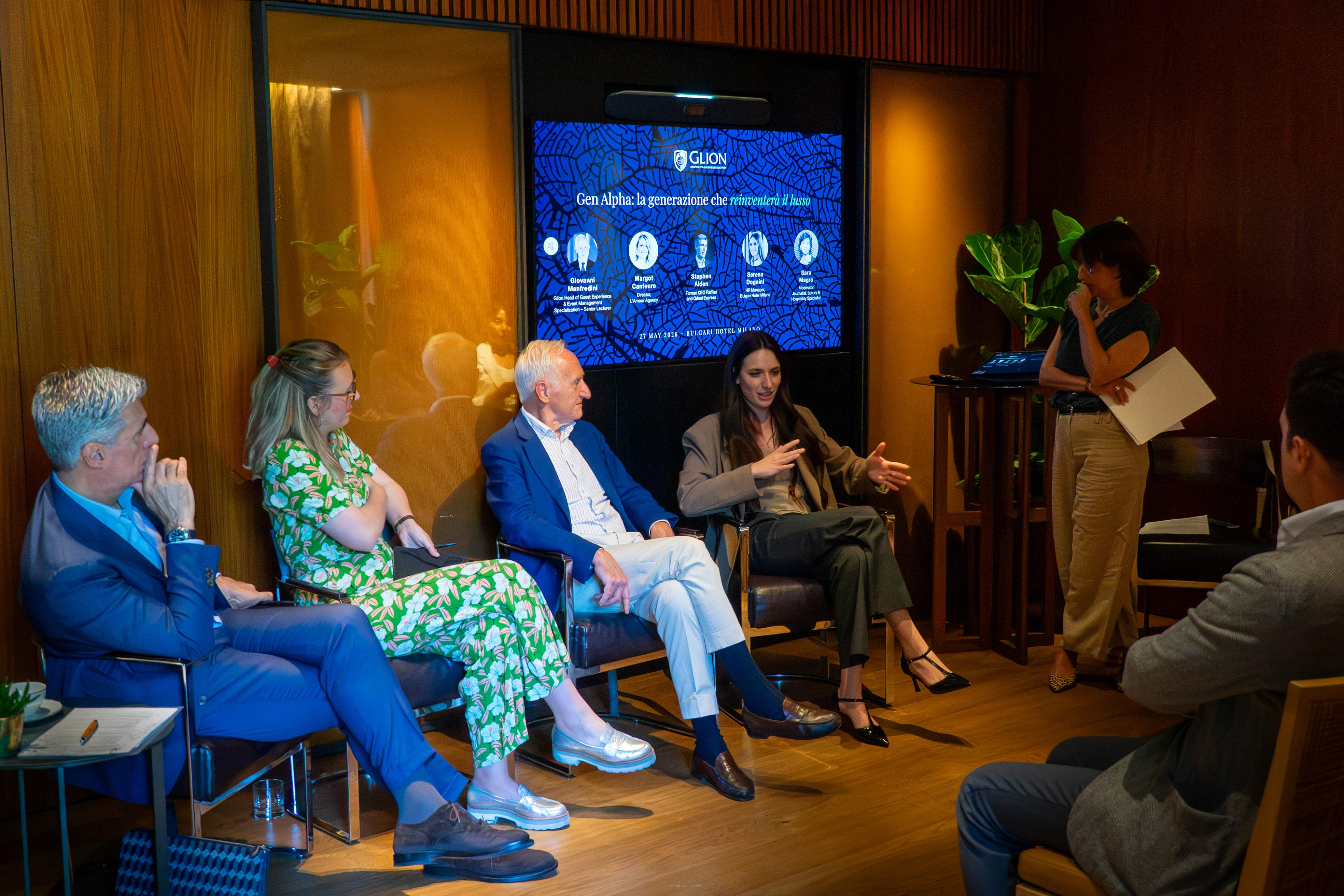
As the luxury and hospitality industries prepare for one of the most significant generational shifts in decades, Glion Institute of Higher Education gathered leading voices from hospitality, branding, luxury and talent management at the Bulgari Hotel Milano for an exclusive roundtable entitled “Gen Alpha: The Generation That Will Reinvent Luxury”.
Moderated by luxury and hospitality journalist Sara Magro, the discussion explored how Generation Alpha – the generation born after 2010 – is expected to profoundly reshape the codes, expectations and business models of luxury in the years ahead. According to Bain & Company, younger generations including Gen Z and Gen Alpha are projected to represent up to 80% of global luxury purchases by 2030, while Gen Alpha itself is expected to become the largest generation in history, with more than two billion individuals globally. Raised entirely in the age of artificial intelligence, hyperconnectivity and permanent digital immersion, Gen Alpha is already influencing brand perception, digital culture and purchasing behaviours long before becoming a fully active consumer generation.
The event highlighted how Glion remains closely attuned to the evolving dynamics shaping the future of luxury hospitality, while actively preparing students and industry partners for the transformations already impacting the sector.
The roundtable brought together:
- Giovanni Manfredini, Head of Guest Experience & Event Management Specialisation at Glion Institute of Higher Education
- Margot Canfeur, Director of L’Amour Agency
- Stephen Alden, Glion Alumnus & former CEO of Raffles Hotels & Orient Express
- Serena Dognini, HR Manager of Bulgari Hotel Milano
Redefining the codes of luxury for a new generation
Throughout the discussion, speakers examined how younger generations are redefining luxury through new expectations around authenticity, sustainability, personalisation, emotional value and cultural relevance. Particular attention was also given to the growing tension between accessibility and exclusivity in an era dominated by social media visibility and permanent digital exposure.
Giovanni Manfredini commented: “For Gen Alpha, luxury will no longer simply be synonymous with exclusivity, but rather with a deeply personal experience built around identity, emotions and individual values. Today’s younger consumers seek authenticity, transparency and meaningful connections with brands: the product alone is no longer enough – what truly matters is how an experience makes you feel. The future evolution of the sector will therefore depend on brands’ ability to create coherent, human and personalised experiential ecosystems.”

The conversation further explored the evolution of luxury hospitality toward more emotional, immersive and experience-driven models, where human connection and meaning increasingly outweigh traditional status symbols. Speakers highlighted how hospitality brands are progressively becoming cultural ecosystems, sitting at the crossroads of lifestyle, wellness, communication and experiential design.
Margot Canfeur added: “Luxury has become culturally accessible through social media, creators and digital content, but precisely because of this, brands must rediscover authenticity and intimacy. Gen Alpha has grown up in the age of algorithms and discovers the world through platforms, influencers and digital communities: this is why brands are now called to build increasingly deep emotional relationships, creating experiences and content capable of conveying meaning, desire and a sense of belonging.”

Balancing technology and human connection
Another major theme addressed during the roundtable was the impact of artificial intelligence and technology on luxury experiences. While AI-powered personalisation, operational optimisation and predictive services are expected to transform the industry, participants emphasised the importance of preserving emotional intelligence, empathy and human interaction as central pillars of hospitality.
Stephen Alden stated: “Artificial intelligence will profoundly transform many operational aspects of the industry, from service personalisation to the efficiency of experiences. However, the true value of luxury will continue to be human: emotional connection, the memory of how an experience made you feel, and the ability to inspire and create wonder will remain central elements in building loyalty and desirability. More than ever, luxury must be capable of creating hyper-personalised experiences that reflect people’s identities and generate long-lasting relationships over time.”

Rethinking talent, leadership and hospitality culture
The discussion also focused on the future of work and leadership in luxury hospitality. As younger generations develop new expectations around flexibility, purpose, inclusivity and professional fulfilment, institutions and employers alike are being challenged to rethink how talent is educated, managed and retained.
Serena Dognini concluded: “Younger generations are looking for purpose, personal growth, flexibility and authentic experiences in the workplace. In luxury hospitality, it therefore becomes essential to value people, listen to them, and make them feel like active protagonists of their professional journey, creating environments based on authenticity, wellbeing, inclusivity and team spirit. Today’s young talents are not only looking for a prestigious brand, but for organisations capable of offering continuous training, genuine attention to people, and a corporate culture aligned with their values.”

Anticipating the future of luxury hospitality
Beyond consumer behaviour, speakers agreed that Gen Alpha is already emerging as a transformative cultural force capable of influencing luxury long before becoming a fully active consumer generation. The May discussion highlighted the importance for brands and institutions to anticipate these shifts today rather than simply reacting to them tomorrow.
By hosting this discussion in Milan – one of Europe’s leading capitals for luxury, fashion and lifestyle innovation – Glion reinforced its positioning at the intersection of hospitality, luxury business education and forward-thinking industry dialogue.
As the boundaries between hospitality, luxury, technology, wellness and culture continue to blur, Glion aims to continue fostering conversations that help shape not only the next generation of professionals, but also the future direction of the luxury and hospitality industries themselves.
Leave a Reply