
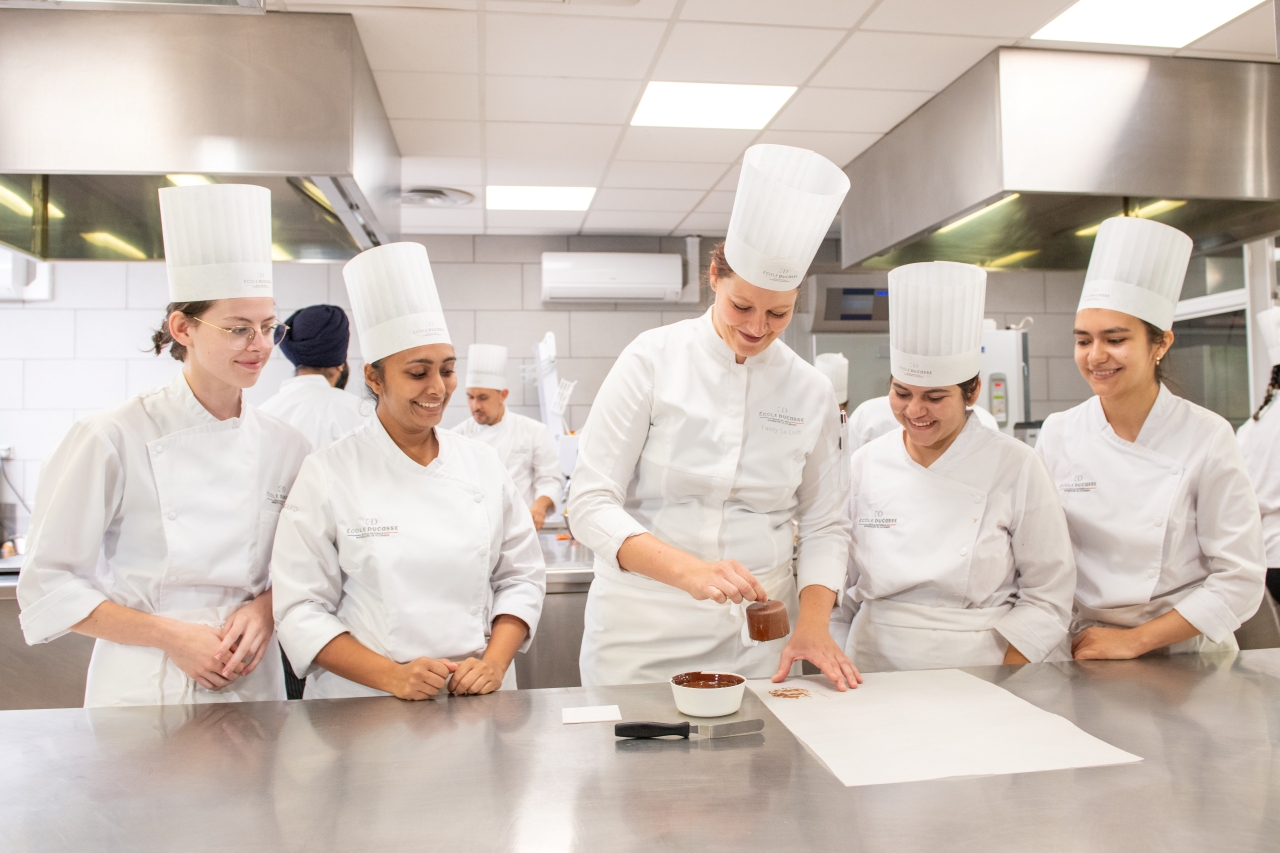
From plant-based gastronomy to culinary medicine, through food waste reduction and less sugary pastry, École Ducasse advocates a vision of gastronomy that cares for ingredients, the environment and people, without ever compromising on pleasure.
What if the future of gastronomy were shaped by one shared ambition: to care? To care for ingredients and natural resources, but also for the people who gather around the table.
As 2027 approaches, École Ducasse identifies several developments that are already transforming chefs’ practices and consumer expectations. From the growing importance of plant-based cuisine to the integration of nutrition into fine dining, these changes reflect a common ambition: to reconcile culinary excellence, pleasure and responsibility.
Far from considering these developments as passing trends, École Ducasse sees them as part of a broader reflection that has been underway for several years, in keeping with Alain Ducasse’s philosophy.
This approach is rooted in an understanding of ingredients, technical mastery and the ability to evolve culinary practices.
For the school, the objective is no longer simply to train chefs to meet the demands of their profession, but also to explore how gastronomy can contribute to addressing major contemporary challenges.

Caring for ingredients: plant-based cuisine, Naturalité and fermentation at the heart of culinary creation
The growing prominence of plant-based ingredients in gastronomy reflects more than a shift in eating habits. It signals a transformation in the way chefs approach their creations. Vegetables, cereals, legumes and seeds are no longer simply accompaniments or alternatives to animal proteins: they are becoming central elements of a genuine gastronomic expression.
This evolution echoes the Naturalité philosophy developed by Alain Ducasse, which prioritises seasonality, respect for ingredients and the pursuit of balanced, authentic flavours. Animal products are not necessarily excluded, but used more selectively, when they bring genuine value to a dish.
Controlled fermentation techniques are also contributing to this rediscovery of ingredients. Lacto-fermentation, koji and other processes allow chefs to explore new depths of flavour, develop acidity and umami, while opening up opportunities for preservation and the fuller use of ingredients. Their application nevertheless requires rigorous control of transformation processes and food safety standards.
In pastry, plant-based ingredients are opening up new possibilities. Beyond replacing butter, eggs or cream, they encourage professionals to rethink textures, balance and flavour combinations without compromising on indulgence.

Julian Mercier, Executive Chef at École Ducasse, explains: “Naturalité is not about giving up the richness of gastronomy, but about reinventing it around the ingredient. Plant-based cuisine now offers considerable creative possibilities, provided chefs master the techniques needed to reveal its full complexity. This is the level of excellence we want to pass on: understanding ingredients, exploring their potential and creating cuisine in which flavour always remains the priority.”
This approach is already reflected in the school’s teaching. Incorporated into its existing Essentials programmes and professional short courses, it will be explored in greater depth from spring 2027 through three new intensive training sessions:
- Essentials of Naturalité, at École Ducasse Paris Campus, starting 9 April 2027: a four-week programme exploring plant-forward gastronomic cuisine, fermentation, seasonality and culinary research, culminating in the creation of a complete menu.
- Vegan Pastry Essentials, at École Nationale Supérieure de Pâtisserie (ENSP), starting 19 April 2027: an English-language programme dedicated to mastering plant-based ingredients and their technical properties across the main disciplines of pastry.
- Les Essentiels de la Pâtisserie Végane, at ENSP, starting 18 May 2027: the French-language version of the programme, enabling professionals to develop a technically accomplished plant-based pastry offering, from entremets and viennoiserie to plated desserts.
These programmes form part of a broader professional development offering which, in 2027, will feature Nadia Sammut exploring free, inclusive and plant-based cuisine, Esteban Salazar focusing on fermentation and Colombian terroirs, and Sébastien Vauxion examining the world of sweet plant-based creations. These different approaches illustrate the diversity of ways in which plant-based ingredients can be expressed in contemporary gastronomy.

Caring for resources: less waste, greater precision
This attention to ingredients goes hand in hand with a broader reflection on the use of resources. According to the United Nations Environment Programme, 1.05 billion tonnes of food waste were generated worldwide in 2022, including 290 million tonnes from food services.
Faced with this challenge, reducing food waste is becoming an integral part of culinary expertise. Making use of trimmings, using more parts of each ingredient, adjusting portion sizes and better anticipating purchasing needs are all practices that combine creativity with responsible resource management.
This approach is also reflected in the evolution of fine dining menus: shorter, more seasonal and more closely connected to local production. By focusing on a smaller number of dishes, chefs can devote greater attention to ingredient quality, cooking precision and the overall coherence of the dining experience.
The responsible use of resources also has its place in culinary education. At École Ducasse, the Naturalité approach includes working with seasonality, maximising the potential of ingredients and culinary research. The new Essentials of Naturalité programme therefore incorporates a Research & Development phase, allowing participants to experiment with different techniques and develop a coherent gastronomic menu centred on plant-based ingredients.
In this approach, responsibility is not an external constraint on creativity: it becomes a driver of excellence and innovation.
Caring for pleasure: towards less sugary pastry without compromising on indulgence
The search for balance is also evident in the world of pastry. Reducing sugar has become an important area of reflection for professionals seeking to create desserts that feel lighter on the palate while preserving their structure, texture and aromatic intensity.
The challenge is not simply to reduce the amount of sugar in a recipe. In pastry, sugar performs several essential technical functions, particularly in preservation, texture and the stability of preparations. Reducing it therefore requires a reassessment of ingredient balance and a thorough understanding of how ingredients interact.
This evolution is part of a broader pursuit of clearer, more distinct flavours: giving greater prominence to fruit, acidity, bitterness and the natural aromas of ingredients. Sugar becomes an ingredient to be used with precision rather than the dominant flavour.
This search for new balances is reflected in several professional training courses offered in 2027. At ENSP, Sandrine Baumann-Hautin will explore summer-inspired health-conscious pastry through gluten-free creations with a low glycaemic index, while at Paris Campus, Luc Baudin will focus on functional and nutritious pastry, combining nutritional performance with gastronomic excellence.
New technologies can also support this exploration. Artificial intelligence, in particular, offers chefs and pastry professionals additional opportunities to develop ideas, visualise plating concepts or imagine the structure of artistic showpieces and entremets before producing them. Its practical applications will also be explored in a 2027 professional training course at ENSP, led by Laurène Fayolle, focusing on the use of AI in pastry professionals’ daily work.
Luc Debove, Director of École Nationale Supérieure de Pâtisserie and Meilleur Ouvrier de France, emphasises: “Artificial intelligence opens up new possibilities in the way we imagine and prepare a pastry creation. It can help us visualise a showpiece, explore combinations of shapes or refine an artistic concept. But it will never replace knowledge of ingredients, precision of technique or the pastry chef’s sensitivity. Our role is to teach future professionals to use these tools with discernment, as accelerators of creativity rather than substitutes for craftsmanship.”
Rather than replacing the chef’s work, these tools enrich the creative process. Knowledge of ingredients, technical mastery and sensory experience remain the foundations of every gastronomic creation.

Caring for people: health-focused cuisine, a new frontier for gastronomy
While Naturalité, food waste reduction and the pursuit of balance reflect a form of gastronomy that is increasingly attentive to its environment, another development could profoundly transform its role in the years ahead: the growing connection between cooking, nutrition and health.
Food plays an essential role in preventing many chronic diseases. The World Health Organization notably highlights that a balanced diet rich in fruit, vegetables, legumes and wholegrains helps reduce the risk of noncommunicable diseases.
Yet beyond nutritional recommendations, a broader question arises: how can the expertise of fine dining be harnessed to make food a genuine contributor to well-being, prevention and care, without ever sacrificing the pleasure of eating?
This is the area in which École Ducasse intends to strengthen its commitment in 2027.
Health-focused cuisine goes beyond the nutritional composition of recipes. It requires an in-depth understanding of ingredients, their properties and how they are transformed, alongside consideration of how culinary techniques can respond to specific dietary needs.
This approach opens up new opportunities for collaboration between chefs, doctors, researchers and nutrition professionals. It also aligns with the development of culinary medicine, which seeks to bridge the gap between scientific knowledge about food and its practical application in everyday life.
This convergence between gastronomy and health is already taking concrete shape in École Ducasse’s 2027 training programme. In collaboration with UniLaSalle, Paris Campus will offer a course dedicated to nutrition in healthcare settings, covering the adaptation of meals to the needs of patients and older people, the prevention of malnutrition, texture-modified foods and techniques designed to preserve the pleasure of eating.
For several years, connections have been developing between these disciplines. École Ducasse now aims to help translate them into more concrete initiatives by encouraging exchanges between healthcare professionals and culinary experts. The school is notably considering events combining scientific conferences and practical cooking workshops, helping doctors translate nutritional recommendations into practical advice for their patients.
However, the ambition extends beyond prevention alone. Gastronomy can also help improve the eating experience of people living with illness, disability or specific nutritional constraints. Working with modified textures, flavours and food presentation is one area in which culinary expertise can usefully complement medical and dietary support.
William Groult, Director of Programmes at École Ducasse, says: “As a driving force for influence and innovation in food in its broadest sense, we are convinced that French haute cuisine has a much wider role to play in our society today.
For more than ten years, connections have been developing between cooking, nutrition, scientific research and health. We are now at a turning point: these connections are gradually translating into concrete action. It is within this context that we aim to make École Ducasse a place where chefs, aspiring chefs, doctors and researchers come together to imagine and build a form of gastronomy that is accessible to as many people as possible. A gastronomy that supports preventive healthcare and can even play a role in the care process, particularly for people for whom the pleasure of eating seems to have lost its place.
At École Ducasse, we firmly believe that haute cuisine should not be reserved for a privileged few: its expertise and exceptional know-how should benefit as many people as possible and make a difference in places where it might not traditionally be expected.”
This vision also has an inclusive dimension. Making the gastronomic experience accessible to people who are often excluded from it, particularly those living with multiple and complex disabilities and their families, is among the avenues being explored by École Ducasse.
The objective is not to turn gastronomy into a medical discipline, but to recognise that chefs’ knowledge and techniques can contribute, alongside healthcare professionals, to improving people’s relationship with food and their quality of life.

A broader role for gastronomy
From the growing importance of plant-based ingredients to health-focused cuisine, these developments point towards a common transformation: a form of gastronomy defined not only by the sophistication of its creations, but also by the care it takes of ingredients, resources and people.
For professionals, this evolution calls for new skills and greater openness to other disciplines. For culinary schools, it means adapting teaching methods, encouraging experimentation and creating opportunities for dialogue between different professions.
True to Alain Ducasse’s pioneering spirit, École Ducasse intends to play an active role in this transformation, combining the transmission of culinary expertise, innovation and reflection on the evolving applications of gastronomy.
In 2027, caring could become one of the most contemporary expressions of gastronomic excellence: caring for ingredients, the environment and, above all, the people for whom we cook.
École Ducasse, part of Sommet Education, also has international schools and studios in the Philippines, India, Thailand and United Arab Emirates.
École Ducasse unveils “Alchimie”: A Christmas log that brings the world to the table
To celebrate the festive season, École Ducasse unveils a pastry creation that is as spectacular as it is symbolic: a globe-inspired sphere with delicate golden accents. Somewhere between a work of art, a design piece and a gastronomic creation, this Yule log boldly reimagines a festive classic while reflecting the international outlook of the renowned culinary and pastry arts school.
A Christmas log that tells the story of the world
More than a festive creation, the Alchimie Yule log embodies the community at the heart of École Ducasse. With over 90 nationalities represented across eight campuses worldwide, École Ducasse brings together students from diverse backgrounds, cultures and walks of life each year.
This diversity enriches the learning experience, fosters open-mindedness and prepares future graduates to thrive in multicultural environments. It has now inspired École Ducasse’s chefs to create this exceptional piece, where geographical boundaries give way to encounters, cultural exchange and the sharing of knowledge.
The continents and the Yule log’s base, delicately crafted and adorned with golden detailing representing the different École Ducasse campuses, become individual fragments of a world brought together in a single creation.
Gastronomy, a universal language
The Alchimie Yule log is also distinctive in the message it conveys. Like culture, gastronomy is universal: it brings people together, sparks curiosity and creates opportunities for sharing. By giving this Yule log the shape of a globe, École Ducasse transforms a festive treat into an experience that goes beyond the simple pleasure of indulgence.
The Yule log’s contemporary design is matched by a masterful balance of flavours, which complement one another to deliver an exceptional tasting experience. It features a crunchy layer of 70% Guanaja chocolate, a Guanaja chocolate sponge, a kumquat compote, a vanilla mascarpone mousse and a Guanaja chocolate mousse infused with smoked vanilla.
“This creation captures in a single image one of École Ducasse’s greatest strengths: its ability to bring together talents and cultures from around the world and pass on the highest standards of culinary and pastry arts,” says École Ducasse Executive Chef Julian Mercier. “We wanted this Yule log to celebrate that diversity through creativity, elegance and a touch of indulgence.”

Practical information
- École Ducasse Alchimie Yule Log | €95 – Serves 8
- Available by pre-order only from 1 December 2026
- Collection: École Ducasse Paris Campus boutique, 16 avenue du Maréchal Juin, 92360 Meudon, France
Leave a Reply